

Homeowners and business owners planning an outdoor upgrade often hit the same wall of confusion online: retailers, bloggers, and even manufacturers use the terms gazebo, pergola, and pavilion interchangeably, even though each one solves a different problem. Comparing a gazebo vs. pergola vs. pavilion determines how much weather protection you get, how you’ll actually use the space, and how much you’ll spend.
Our comprehensive guide breaks down what separates a gazebo, a pergola, and a pavilion so you can match the structure to your yard, your climate, and your plans before you spend a dollar.
Gazebo vs. Pergola vs. Pavilion: Comparing Backyard Shade Structures
Gazebo, pergola, and pavilion rank among the most searched backyard shade structures, yet people lump the three into one generic category far too often.
Each type of outdoor structure shades a patio differently, stands up to weather on its own terms, and brings benefits the other two can’t match.

What Is a Pergola?
A pergola is an open-air structure with vertical posts and horizontal beams, topped with a slatted or lattice-style roof that filters sunlight instead of blocking it outright. For homeowners who want a pergola’s open-air look with added protection from sun, wind, or rain, Country Lane’s EZ Shades attach directly to a pergola for adjustable, on-demand coverage.
However, the real value of a pergola shows up in how people utilize one: you’ll find it as a defined patio cover, a stunning shaded walkway, or a picturesque frame for an outdoor kitchen or dining area.
Pergola Styles: From the Minimalist Vista to the Dramatic Kingston
Country Lane builds pergolas in several distinct styles, each with its own roofline, post detail, and personality, so the structure matches your home instead of looking like an afterthought placed in the yard.
Here are some of the most popular pergola styles people fall in love with every day:
- Vista Pergolas: Clean lines and a stripped-back profile for anyone who wants shade without visual clutter.
- Hollander Pergolas: Our most popular collection, with substantial timber framing that suits almost any home style.
- Traditional Pergolas: Open-rafter construction and symmetrical post spacing built to hold its look for decades.
- Artisan Pergolas: Available in cedar or vinyl with upgraded detailing for a more polished, estate-style finish.
- Kingston Pergolas: Cedar construction with the boldest roofline in our lineup, built for a dramatic, high-end finish.
What Is a Pavilion?
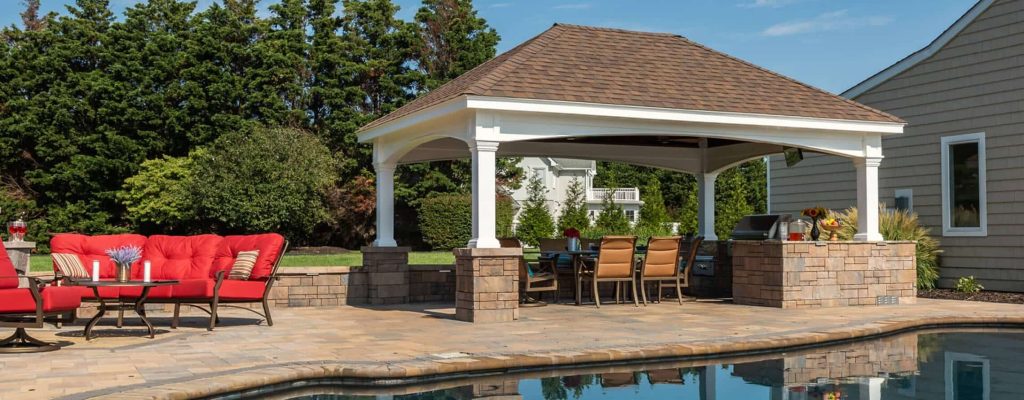
Restaurants, resorts, and backyards meant for entertaining all gravitate toward the same structure, and for good reason. A pavilion replaces the slatted pergola roof with a solid, weatherproof cover that blocks rain, snow, and direct sun completely. This is a fully roofed, open-sided structure that shelters everything underneath it without ever feeling closed in.
Pavilion Styles: From the Traditional A-Frame to the Grand Estate and Palation
Country Lane’s pavilion lineup runs wider than most competitors offer, starting with the A-Frame Pavilions, a steep double-slope roof built to shed rain and snow fast, and the cedar-forward Alpine Pavilions for a more rustic finish.
The Hampton Pavilions and Bellavue Pavilions bring hip-roof profiles and all-weather vinyl for owners who never want to touch a paintbrush again, while the Santa Fe Pavilion uses a single-slope design built to attach directly to a home or patio.
For projects that need serious square footage, the Grand Estate Pavilions scale up to 24×24 feet, and the Palation Pavilions go even larger, great for resorts, wedding venues, and estates that need a structure with real presence.
When selecting the ideal pergola for your property, understanding different materials for your luxury pergola is essential for making an informed investment. At Country Lane Gazebos, we’ve spent over 30 years crafting premium outdoor structures from wood and vinyl, with aluminum options coming soon to expand our collection. Choosing the best pergola material directly impacts your investment’s longevity, maintenance requirements, and overall value.

What Is a Gazebo?
Walk through any park, resort, or high-end backyard, and the structure that catches your eye first is usually a gazebo, a freestanding structure with a full roof and partially enclosed sides, most often built in a round, octagon, or oval shape.
Gazebo Shapes and Upgrades: Octagon, Oval, Screened, and Cupola Options
Country Lane gazebos come in more shape options than most manufacturers offer, and every shape supports the same upgrades once you’ve picked your footprint. Here’s what you can find:
- Octagon Gazebos: the most requested shape, with eight equal sides and a pagoda-style roof option for extra height.
- Oval Gazebos: an elongated footprint built for narrow yards or spaces that need more bench and seating room than a round structure allows.
- Dodecagon Gazebos: a twelve-sided design for a larger footprint without losing the classic gazebo silhouette.
- Rectangle Gazebos: a linear shape that fits closer to a home’s architecture than a traditional round build.
- Screened-In Packages: mesh panels built into any shape to keep bugs out without blocking airflow.
- Cupola Upgrades: a raised roof accent that adds height, ventilation, and a finished look to the peak.
Every shape above is available in wood or vinyl, and each one runs through our online 3D builder before it ever reaches your yard.
Outdoor Structure Comparison: 5 Factors to Help You Choose
Every one of these three structures looks great in a photo, but the perfect pick for you comes down to how it enhances your property. Before making a purchase, run your decision through these five factors:
- Weather Protection: A pavilion’s solid roof blocks rain and snow outright, a screened gazebo adds a barrier against wind and insects, and an open pergola only manages direct sun unless you add a shade or curtain system.
- Use Case: A pergola works well over a grill station or casual lounge area, a pavilion handles large group dining or a permanent outdoor living room, and a gazebo creates a quiet focal point for a hot tub, reading nook, or a spot you want visible from across the yard.
- Yard Size and Placement: Pergolas attach easily to a home or deck and work in tighter spaces, pavilions need enough open ground to stand freestanding at full size, and gazebos perform best set apart from the house entirely, often near a garden or water feature.
- Maintenance Commitment: Vinyl gazebos, pergolas, and pavilions need nothing beyond an occasional rinse, wood versions need restaining every few years, and gazebos with screens or cupolas add a small amount of extra upkeep around those specific components.
- Budget Range: Pergolas typically cost the least of the three since they use the least material, pavilions run higher due to the full roof structure and larger footprint, and gazebos land anywhere in between depending on shape, size, and how many upgrades you add.
Taking the time to consider these factors helps you better understand your outside space and how you want to utilize it. Then, you’ll be able to make your space as functional – and as comfortable – as you want.
Design Your Perfect Outdoor Structure with Country Lane Gazebos
Whichever direction you land on after this gazebo vs pergola vs pavilion breakdown, Country Lane builds all three the same way, hand-crafting each one in Lancaster County, PA, with more than 30 years of Amish craftsmanship behind it.
Come see the difference in person at our indoor and outdoor Display Park in New Holland, where you can walk through real gazebos, pergolas, and pavilions side by side before you decide. From there, schedule a free consultation or start customizing your pick in our online 3D builder.
Frequently Asked Questions About Gazebos, Pergolas, and Pavilions
Can I convert a pergola into a pavilion later by adding a solid roof?
Technically yes, but it’s rarely a simple swap. A pergola’s frame typically carries only the weight of an open lattice roof, so converting it into a full pavilion means reinforcing the posts and beams first to handle the added weight and wind load. Loop in a Country Lane specialist before you start, since planning for that upgrade works best from the beginning. If you want more weather protection without a full structural conversion, EZ Shades are a simpler option that adds coverage to an existing pergola without reinforcing the frame.
Do all three structures – pergolas, pavilions, and gazebos – require the same type of foundation?
Not exactly. Pergolas and pavilions typically sit on a concrete pad, paver base, or reinforced deck since they carry more structural weight, while a gazebo can often work with a simpler foundation like gravel or a wood floor system, depending on size and local codes. Your dealer will confirm the right base once you’ve picked a structure and size.
Will one structure add more home value than another?
All three typically boost home value, but the amount depends more on quality and placement than on which structure you pick. A well-built, professionally installed pergola, pavilion, or gazebo reads as a permanent outdoor living upgrade to appraisers and buyers alike, while a flimsy or poorly placed structure can actually work against you. Material and craftsmanship matter more than the shape of the roof.

